
Ceramic Matrix Composites
CMCs provide high temperature oxidation stability relative to metals and enhanced toughness relative to monolithic ceramics. Ultramet offers durable, refractory Ceramic Matrix Composites that survive the severe environments of propulsion and thermal management systems. Because they are fabricated through a rapid melt infiltration process, Ultramet CMCs are far less costly than composites made by conventional chemical vapor infiltration.
Melt Infiltration for Ceramic Matrix Composites
The superior strength, temperature capability, and size of Ultramet Ceramic matrix composites (CMCs) are achieved through melt infiltration, a unique process driven by Ultramet’s expertise in chemical vapor deposition.
Process
- Obtain fiber preform—wrapped/layup/woven/braided.
- Apply interface coating(s) via low temperature, ultraviolet-activated chemical vapor deposition (which eliminates fiber damage).
- Partially densify preform with sacrificial carbon to react with the molten metal to form the carbide and to prevent reaction with the fiber reinforcement.
- Infiltrate with molten metal to react with the sacrificial carbon and form the fully dense carbide matrix.
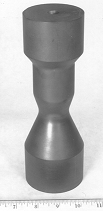
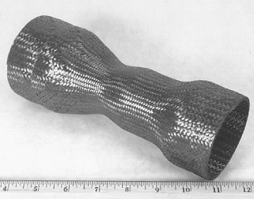
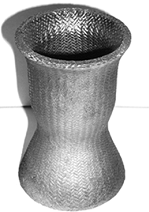
Three stages in fabrication of ceramic matrix composites combustion chamber: left, graphite thruster mandrel; center, braided fiber preform after interface coating and sacrificial carbon infiltration; right, thrust chamber after melt infiltration
Advantages of Melt Infiltration
- Significantly reduced process time relative to chemical vapor infiltration, which can take weeks depending on part geometry, whereas melt infiltration takes a few hours
- High density (>98% theoretical density)
- Minimal matrix microcracking
- Applicability to thick section and complicated preform geometries
- Inexpensive raw materials
- Reduced costs compared with chemical vapor infiltration, particularly for increased-scale components
- Controllable matrix compositions such as ZrC, HfC, TaC, NbC and mixed carbides
- Ability to be diffusion-bonded to carbon/carbon primary structures to take advantage of the high strength/low density of carbon/carbon and the high toughness and oxidation resistance of Ceramic Matrix Composites (CMC)