Ceramic Protective Coatings
Ultramet applies protective coatings to carbon/carbon and ceramic matrix composites, graphite, refractory metals, and superalloys for operation in severe environments. Low temperature deposition (<752°F [400°C]) is possible to accommodate components with low melting points.low melting points.
Advantages
- High temperature oxidation protection for refractory metal- and carbon-based components
- Deposition at temperatures as low as 10% of the melting point of the coating material
- No porosity (fully dense)
- Availability in various metal carbides, oxides, nitrides, and borides
- High emissivity
- Thermal protection
- Applicability to intricate shapes and textured surfaces
Applications
- Engine and airframe components
- Fiber interface coatings
- Thermal protection system components
![]() ![]() |
![]() |
![]() |
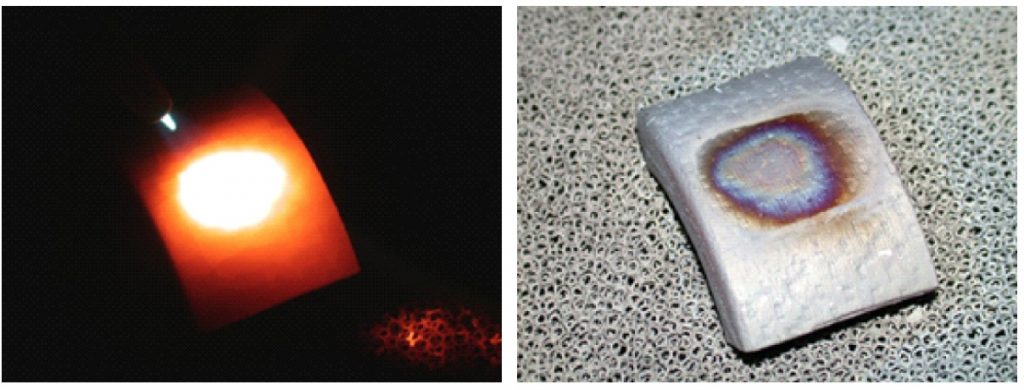
Oxyacetylene torch testing showing oxidation stability of carbide-coated carbon/carbon specimen
Refractory Carbides
Hard, wear-resistant, chemically inert, chemically resistant, and nearly impervious to hydrogen at high temperatures, refractory carbides can be formed by chemical vapor deposition at temperatures as low as 10% of their melting point. Ultramet offers the following materials, along with other carbides, nitrides, and silicides:
|
![]() |
Layered Hafnium Carbide/Silicon Carbide
Ultramet has developed a hafnium carbide/silicon carbide (HfC/SiC) coating applied in layers by chemical vapor deposition that provides outstanding oxidation resistance at high temperatures.
![]() |
SEM image of polished cross-section of Ultramet HfC/SiC coating (1500×) showing layered structure
Advantages
- Higher use temperature than silicon carbide or silicon nitride in an oxidizing environment because a highly stable and protective hafnium silicate forms at the surface
- Survivability demonstrated through hot-gas testing at NASA Ames, NASA Johnson, and Arnold Engineering Development Center
- Protection to 3270°F (1799°C) for extended periods (hours) and to >3800°F (2093°C) for shorter periods
- Zero ablation demonstrated at heat flux levels up to 320 Btu/ft2 · sec (363 W/m2); ablation rate of 0.0002 in/sec (5 µm /sec) was measured at 525 Btu/ft2 · sec (595 W/m2)
- No visible damage in rain erosion testing up to 500 ft/sec relative velocity and 90° angle of attack
- Low thickness required (0.003–0.005"); >0.020" thickness possible
- High emissivity (0.8–0.85) leads to a 300–500°F (159– 260ºC) reduction in surface temperature relative to alternative ceramics tested at the same heat flux
![]() |
![]() |
| Photographs of 300-second arcjet test performed at NASA Ames on a carbon/carbon nose cone coated with layered HfC/SiC. Heat flux was 389 W/cm2, and no mass or dimensional change was evident. Upper, 15 sec into test; lower, 295 sec into test. |
Refractory Oxides
Ultramet has developed processes for fabricating coatings of the following refractory oxides (other oxides can also be deposited):
|
Ultramet applies these refractory oxides by chemical vapor deposition as a 100% dense, pinhole-free coating on refractory metals, ceramics, and composites. Used for resistance to high temperature oxidation and corrosion (e.g. sulfur and vanadium), these coatings can extend either the service life or operating temperature capability of many components, including rocket nozzles, piston heads and liners, turbine blades, and fuel-fired heat exchanger components.

Yttria-stabilized Zirconia Thermal Barrier Coating
Yttria-stabilized zirconia is applied by low temperature (1292°F [700°C]) chemical vapor deposition to create a cost-effective, robust thermal barrier coating that can be applied to complex-shaped components. The coating is suitable for nickel-based superalloy turbine engine components.
|
|
Yttria-stabilized zirconia coating showing columnar microstructure (left) and coating conforming to substrate edge (right)
Advantages
-
Suitable for complex-shaped components and applications not readily coated by line-of-sight electron beam physical vapor deposition or plasma spray processes
-
Low temperature deposition for superalloy turbine engine components
-
Low thermal conductivity
-
Compatible with MCrAlY, nickel aluminide, and platinum aluminide bondcoats
Ultrahigh Temperature Ceramic Coatings
For less oxidizing applications that experience higher temperatures, Ultramet can apply hafnium carbide, tantalum carbide, or zirconium carbide as coatings or matrices within composites.
Properties of Selected Ultrahigh Temperature Ceramic Coatings

High-Reflectivity Coatings
Ultramet coatings of the following refractory carbides combine high reflectivities with high temperature capabilities and provide hydrogen resistance for carbon and carbon/carbon components.
|
Coatings for Electronic Devices
Ultramet coatings for dielectric, insulative, conductive, and controlled work function materials deliver superior electron emission properties and can be applied to refractory substrates including molybdenum, niobium, tungsten, and silicon carbide. Dielectric coatings such as tantalum pentoxide and titanium oxide and insulators such as boron nitride and silicon nitride are available.
The following coatings developed for other applications are excellent choices for contacts and conductors:
|